
Michael Robb: Director of research at Common Sense Media, overseeing the organization’s research, survey development, and program evaluations. Over the last 15 years, he has conducted numerous studies of children’s media use, as well as supervised a range of community outreach efforts, helping parents and teachers make the most of quality children’s programming. In addition to his work at Common Sense, he has published in a variety of academic journals on topics such as the impact of electronic media on young children’s language development, early literacy outcomes, and problem-solving abilities.
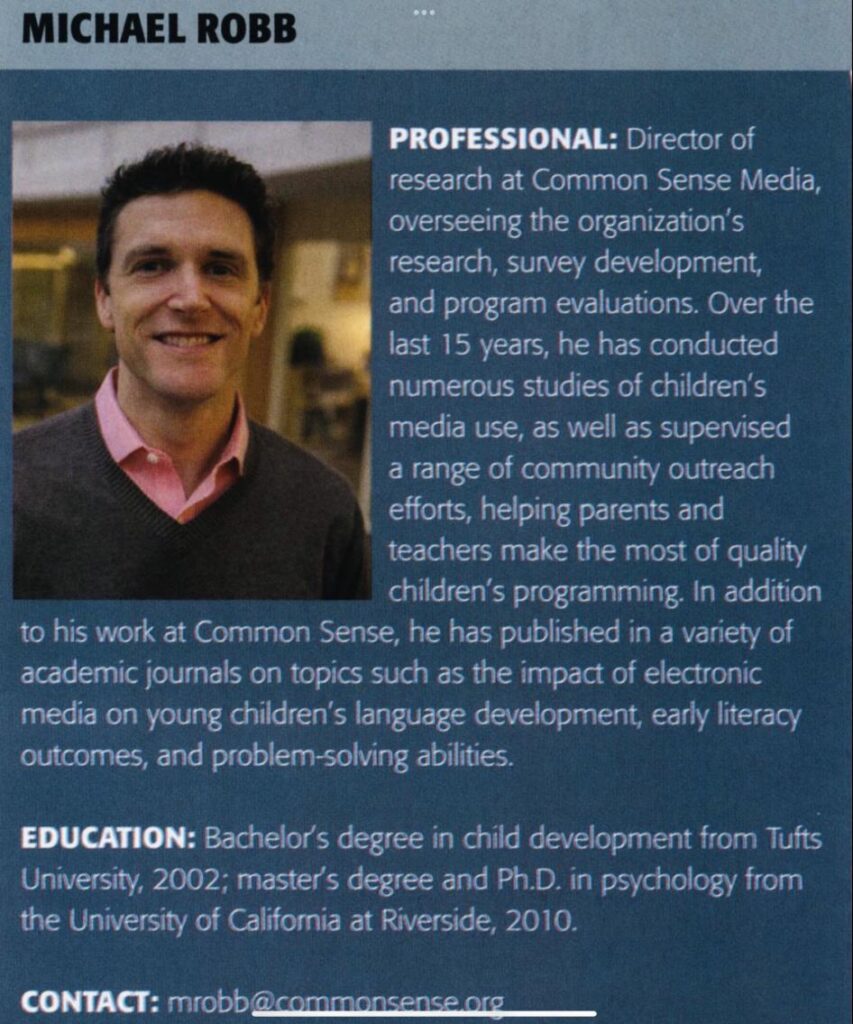
Education: Bachelor’s degree in child development from Tufts University, 2002; master’s degree and Ph.D. in psychology from the University of California at Riverside, 2010.
The following are a few questions Dr. Michael Robb answers in his interview titled, The data on children’s media use: An interview with Michael Robb.
Technology and Addiction
KAPPA(Interviewer): Can you give an example of how the research challenges a popular belief about kids’ media use?
ROBB: A couple of years ago, we did a study about technology addiction, and the issue ended up being much more complicated than I expected. For example, we found that among researchers and psychologists, there’s no real agreement as to what technology addiction is, how it could be measured, or how prevalent it might be. It seems clear that there are some kids out there using technology to excess, and that it’s having a negative impact on their lives, but it’s difficult to say much more than that. The press likes to use a broad brush, saying that a lot of kids are “addicted” to their cell phones or computer games. But when experts talk about addiction, they mean that a problem behavior gambling, for example, or taking drugs – has gotten to be so severe that a person can no longer function in everyday life and needs some sort of external support to get back on track. We’ve found that when it comes to the amount of technology kids consume,
what many parents experience can better be described as frustration or disappointment. Very rarely does a kid’s technology use rise to the level of pathology. So, rather than being quick to use a loaded term like addiction, I’d like to see more research into what’s really going on: Can we get a clearer picture of the ways in which constant cell phone use, for example, affects kids’ cognitive, physical and social-emotional development? And are tech designers unfairly designing products to take advantage of kids’ attention?
Again, that’s not to say there aren’t areas of concern. For example, it’s clear that multitasking impairs people’s ability to focus, and it’s clear that most kids engage in a significant amount of it. As far back as 2010, research found that when 8- to 18-year-olds used media, they spent about a third of the time using two or more media simultaneously for example, surfing the web while listening to music. In real time, they were engaged with media (including both screen media and music) for 7 and a half hours per day, on average. But since they were cramming more than one kind of media into the same period of time, they were actually engaged with almost 11 hours of media content over those 7 and a half hours. Young people don’t think it’s harming their ability to get things done, though. In a 2015 survey, we found that large numbers of teens and tweens were
watching TV and texting while doing homework, and they didn’t think it was affecting the quality of their work. But of course, there’s no such thing as true multitasking (in reality, people just shift back and forth between tasks), and attempting to do so impairs one’s ability to create memories that can be retrieved accurately later on. In fact, the people who say they’re good at it – the heaviest media multitaskers turn out to do worse at remembering key details and filtering out irrelevant information than those who don’t multitask, or do so lightly.
Parents and Internet Use
KAPPAN (Interviewer): Has your research raised any other big concerns about kids’ media use?
ROBB: Actually, it’s parent media use that’s made me concerned recently, especially when it comes to parents of young children. We know that children tend to thrive when they have a lot of language-rich, warm, supportive interactions. If parents are spending much of their time on digital devices, that can displace those interactions and have a negative effect on their kids. There isn’t a ton of research on this issue yet, and it’s hard to measure parent distraction, but some small, preliminary studies have shown that parents who were distracted by their devices tended to be harsher with their kids, and their kids tended to act out more as a way to get their parents’ attention.
The full interview can be found here: https://www-jstor-org.umw.idm.oclc.org/stable/44653417?sid=primo&seq=1
Since 2003, Common Sense Media (directed by Dr. Michael Robb) has been a leading source of entertainment and technology recommendations for families and schools. Every day, millions of parents and educators trust Common Sense reviews and advice to help them navigate the digital world with their kids. Together with policymakers, industry leaders, and global media partners, Dr. Robb is building a digital world that works better for all kids, their families, and their communities.
The Common Sense Media website: https://www.commonsensemedia.org/about-us/our-mission
Content By Brandon Payton
